The first photographs?
When was photography really invented?
Exclusive to MeierMovies, January 11, 2026
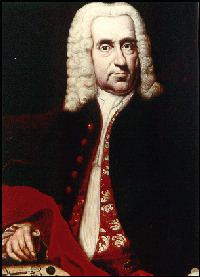
Johann Heinrich Schulze
The first photograph, View from the Window at Le Gras, was taken in 1827 by Joseph Nicéphore Niépce, or so the story goes. (Go here for more information on that groundbreaking “heliograph.”) But what if the first photographic image had been created more than 100 years earlier?
It might have been.
As with other major inventions, many people were working on developing photography at the same time. As early as the first decade of the 1800s, Thomas Wedgwood and Humphry Davy had some success but couldn’t produce permanent images. And around the same time as Niépce, Louis Daguerre (whom most consider the father of photography) was conducting his experiments. Slightly later, William Fox Talbot made significant advances.
But there was an outlier nearly a century earlier: German professor and inventor Johann Heinrich Schulze, who, astonishingly, in 1717 (using a slurry of chalk, nitric acid and silver nitrate) proved that silver salts darkened with light. And he apparently captured an image. However, he failed to make it permanent.
But what if he had? What if his experiments had advanced to the point of Niépce’s? Imagine the implications.
The world could have had photography 100 years earlier. Benjamin Franklin, Thomas Jefferson, Marie Antoinette, Wolfgang Amadeus Mozart, King George III. We could have photographs of them all.
And what if motion pictures had followed the same timeline, being developed about 60 years following photography? We could have had silent movies of the French Revolution, the inauguration of President George Washington and the War of 1812. The American Civil War would have been filmed in color, just like the Vietnam War. And footage of World War II would have been shot in 3-D and high frame rate, or whatever cinematic inventions lie ahead.

Pont Neuf, by Louis Daguerre and Mathurin Joseph Fordos. (Click to enlarge.)
In another, slightly more realistic twist on history, the famous Boulevard du Temple Daguerreotype created by Louis Daguerre in Paris in 1838 might not have been the first to feature people, as another Parisian Daguerreotype (created with his partner, Mathurin Joseph Fordos) might hold that title: Pont Neuf. The trouble is we don’t know exactly when it was made. Some suggest as early as 1836 while others claim 1839. Adding to the confusion is the fact that the human figures are not nearly as clear as in Boulevard du Temple. You decide: Are the two figures resting against the fence, in the shadows in the lower left, people, or just an illusion?

As John Adams reminded us, facts are stubborn things. Too bad we don’t have film of him saying it.
© 2026 MeierMovies, LLC