Blue Moon
Blue Moon, 2025, 3 ¾ stars
Hart strings
Hawke soars as legendary lyricist
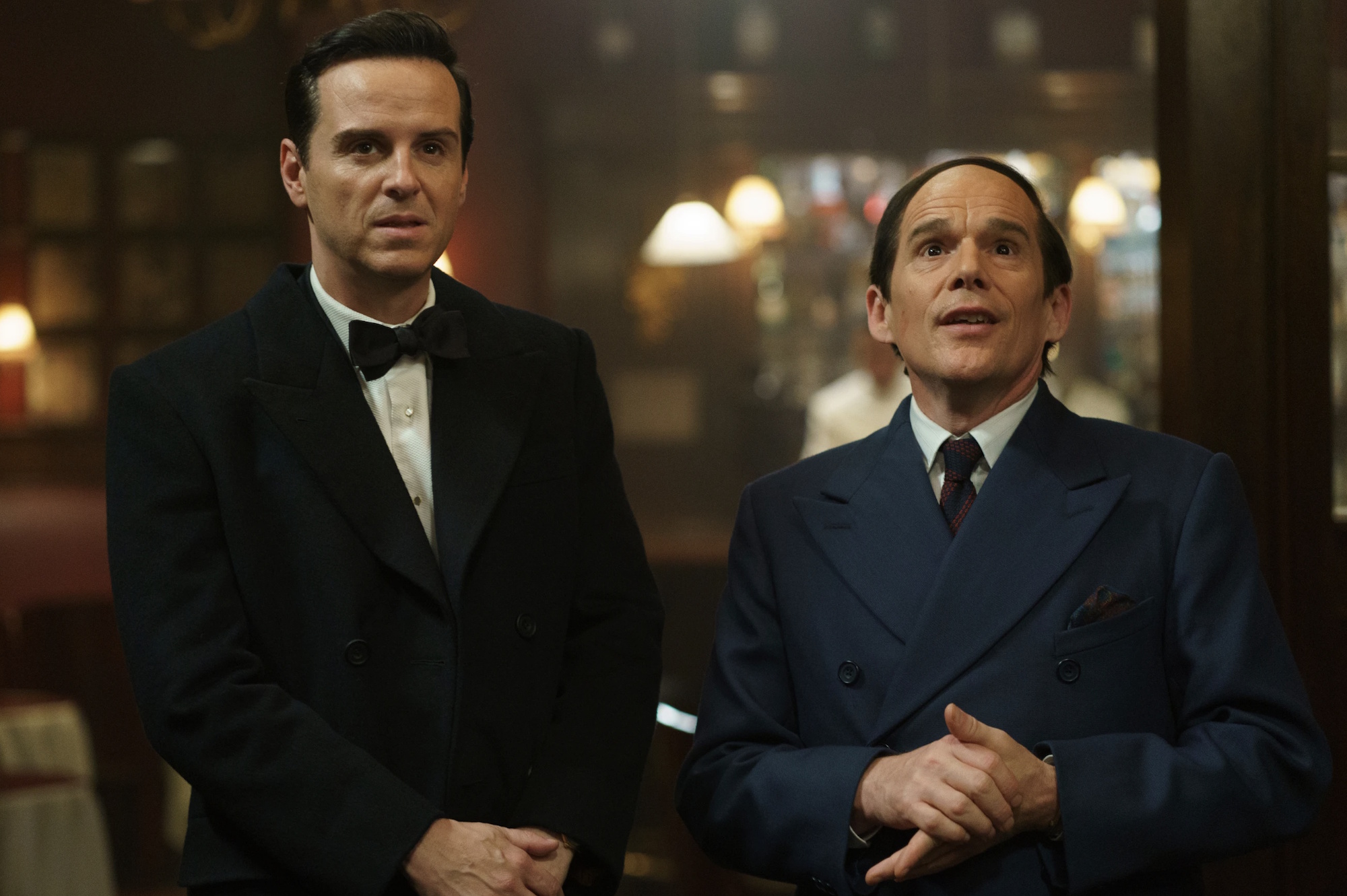
Andrew Scott, left, is Richard Rodgers to Ethan Hawke’s Lorenz Hart. (Image is copyright Sony Pictures Classics.)
Exclusive to MeierMovies, October 24, 2025
“Did you ever think your entire life is a play, and that 99 percent of the people in it … got no lines, you know? Just like extras. And you? You’re an extra in their play.”
This Shakespearean observation by Eddie the bartender in director Richard Linklater’s Blue Moon seems fitting for the film’s subject, legendary lyricist Lorenz Hart. After all, while Hart (“Larry” to his friends) is the undeniable center of his own universe – at least in the context of this one-location, real-time drama – he is slowly drifting into the outer orbits of his friends’ lives and of American musical culture in general.
Set mostly on the evening of March 31, 1943, at New York City’s Sardi’s restaurant, following the opening of Rodgers and Hammerstein’s Oklahoma!, Blue Moon shines a beam on the mental and physical deterioration of 47-year-old Hart, just a few months before his death. Oklahoma! was the first collaboration between Richard Rodgers and Oscar Hammerstein II, and Rodgers’ first musical without Hart. So, predictably, attending the after-party and congratulating his former musical partner is a painful, swallow-your-pride moment for Hart.
Adding an additional emotional burden to Hart’s load is an expected rendezvous with his friend and protégé, Elizabeth Weiland, with whom he also happens to be in love, despite her being 27 years his junior and much taller, and despite Hart being more inclined toward men. It’s a recipe for the most awkward evening since Who’s Afraid of Virginia Woolf?
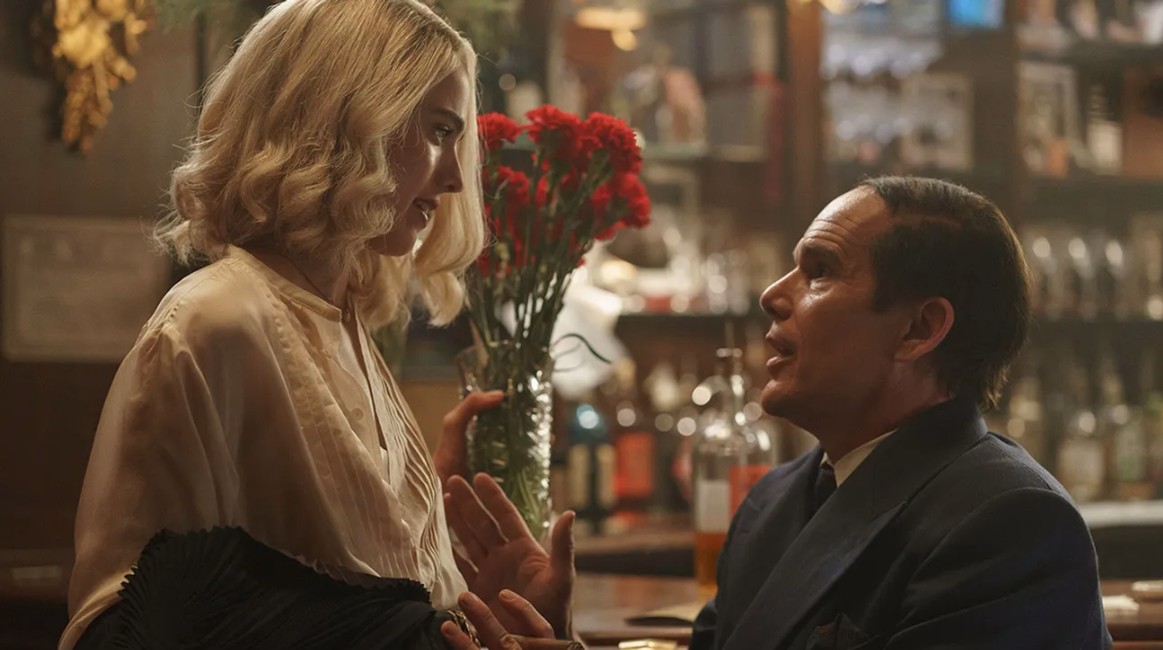
Margaret Qualley lends solid support to Ethan Hawke.
Blue Moon features another towering performance by Ethan Hawke, in yet another memorable collaboration with Linklater. Remarkably, Hawke has never received an Oscar nomination for lead actor, but that streak of bad luck will likely be broken next year. (He has been nominated twice for writing and twice for supporting performances but has never won.) A possible contender for supporting actor is the always mesmerizing Andrew Scott as Rodgers. Lending further, fine support are the loveable, relatable Bobby Cannavale as Eddie; the ethereal Margaret Qualley as Elizabeth Weiland; and the charmingly erudite Patrick Kennedy as author E.B. White, whose presumably fictional bar-side conversation with Hart offers a playful twist on the origin of the character of Stuart Little.
Speaking of little, Hart was barely 5 feet tall while Hawke is around 5’10’’. The transformation of Hawke is both subtle and, at times, startling, and is achieved through practical, traditional means. One is reminded of the 1952 version of Moulin Rouge, directed by John Huston, in which José Ferrer plays Henri Toulouse-Lautrec. One might also recall the famous line from W.C. Fields in the 1932 classic short film The Dentist: “Is he standing in a hole?” Well, yes, as a matter of fact, Hawke is, at least in a couple of scenes.
As with most Linklater films, Blue Moon has tons of talking. But it also has almost no action. (Think My Dinner with Andre.) That’s not a problem until just past halfway, when an extended conversation between Hart and Weiland almost overstays its welcome. But if you have the patience to stick with it, the emotional payoff from that scene is impressive.
The aforementioned literary nugget involving White is not the only make-believe that writer Robert Kaplow includes in his screenplay. While based on real events and real people, Blue Moon falls into that delicious but morally complicated group of “didn’t happen but could have” movies. Yes, Hart did apparently attend the party, though history doesn’t record definitively whether it was at Sardi’s. And he did congratulate Rodgers, though Hart’s tastes leaned away from the sentimental Americana of Oklahoma! The interactions with the bartender, White and another famous composer (a child at the time) are almost certainly fictional. Most interestingly, the Elizabeth character is based on a real person, and the correspondences between her and Hart partially inspired this story, though her presence at the party is apparently invented. But is this screenplay true to the nature of the real people, and, just as importantly, could the events have happened as presented?
Probably, but one can’t be sure, and, frankly, that bothers me, but not enough to begin to spoil one of Linklater’s finest films, and perhaps his saddest. Is Blue Moon a one-note movie? Yes, but, like “Blue Moon” and the other wonderful Rodgers-Hart tunes, it has an unforgettable melody. And like the little pet mouse that Hart describes to White, the entire film – and Hart himself – have what Hart calls a “New York look of doomed hopefulness.”
© 2025 MeierMovies, LLC
For more information on the movie, visit IMDB and Wikipedia. The film is currently in cinemas.