Nuremberg
Nuremberg, 2025, 3 ½ stars
Trial and tribulations
Nuremberg examines Göring prosecution
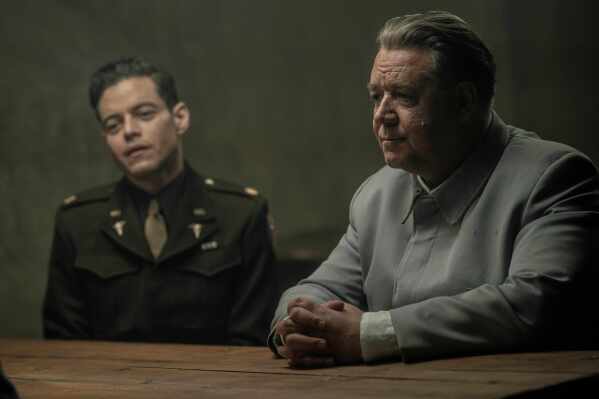
Rami Malek, left, and Russell Crowe star in Nuremberg. (Image is copyright Sony Pictures Classics.)
Exclusive to MeierMovies, November 6, 2025
With deference to Jesus Christ, the “greatest story ever told” is really the tale of how humans have treated fellow humans throughout history, especially during war. And the most impactful of those tales is likely that of the Nazis.
Because they are so important, you’d think all Nazi stories had already been told. But there is at least one that, until now, had not been brought to the screen. It is the relationship between Hermann Göring and his American psychiatrist prior to the Nazi’s Nuremberg trial in 1946.
Based on the 2013 book The Nazi and the Psychiatrist by Jack El-Hai, Nuremberg follows Göring from the fall of Germany in 1945 until his scheduled execution following his trial at Nuremberg in 1946. But the central character in writer-director James Vanderbilt’s film is really psychiatrist Douglas Kelley, who, despite his having fought in World War II, seems to treat Göring as just another patient when they first meet. Indeed, he seems impressed by his intellect and is hesitant to violate doctor-patient confidentiality. It’s only after the weight of the Nazi atrocities come to light in the trial that Kelley fully realizes the horror who sits before him, in the form of 53-year-old fat sociopath.
“If we could psychologically define evil, we could make sure something like this never happens again,” Kelley conjectures. He even contemplates writing a book about Göring. But his first task is to make sure the Nazi second-in-command is mentally fit for trial, and the film spends a lot of time on that, before going deeper into related people and events, including the trial itself, which, predictably, is the narrative’s most riveting part.
I have not read El-Hai’s book and am not a Göring scholar, but I suspect the film took liberties in presenting an almost bi-polar Kelley, with the first version treating his patient objectively and the second working as hard as possible to punish a monster in human form. It might not be entirely believable, but it makes for good cinema. It also affords the filmmakers a chance to present horrendous, real footage of the Nazi death camps while reminding us that the people who committed the Shoah were not aliens or mutants. They were just like us. And fascism never dies. It only sleeps.
Nuremberg is just the second directorial effort from Vanderbilt, following Truth in 2015, starring Robert Redford. He’s better known as a producer and writer, and he penned the screenplay for Nuremberg, in addition to co-producing it. As with Truth, his writing and direction are competent but a bit too “by the book,” lacking stylistic punch and surprise. The characters’ conversations, at least in the first half, are also a bit pedestrian. In addition, the film is initially flawed tonally, embracing an almost odd, light-hearted touch, before dropping the emotional hammer during the trial sequences. The contrasting styles serve a purpose but might not have been the best choice.
Further holding the film back from greatness is a performance from Rami Malek that is just acceptable. (I kept imagining Alden Ehrenreich in the role, perhaps because I had just seen his fine work in Weapons.) Malek has memorable moments, but he’s outclassed by Russell Crowe, who, as Göring, does his best work in years. Concerning dialects, an actor’s most difficult job is to master the native sound of a language other than his own. Tasked with speaking a lot of German, Crowe does his best, but a native German would not be fooled. When speaking English with a German accent, however, Crowe is highly effective. (Göring did speak English, but not as well as in the film.)
The supporting cast is led by Michael Shannon as Supreme Court Justice Robert Jackson, who was the lead prosecutor of Göring and the other Nazis being tried with him. Cast slightly against type, Shannon is as compelling as always and makes one wish for a script that focused more on his character. Richard Grant also does fine work as David Maxwell Fyfe, an assistant prosector. Grant’s prosecutorial examination of Göring is the film’s highlight and is the only time the movie rises to the level of the superior Judgment at Nuremberg, from 1961. That film focused on a different event (the Judges Trial of 1947), and though it was largely fictional, it was simply a much better movie than Vanderbilt’s, with an Oscar-winning performance from Maximilian Schell and an Oscar-nominated one from Montgomery Clift, despite the latter appearing in just one scene.
Despite its predictability and lack of nuance, Nuremberg is an essential watch for these times, or any time. It’s not necessarily one of the best films of 2025, but it is one of the most important.
© 2025 MeierMovies, LLC
For more information on the movie, visit IMDB and Wikipedia. The film opens in cinemas on November 7.