One Froggy Evening
One Froggy Evening, 1955, 5 stars
Shadows and Frog
Merrie Melodies aren’t so merry
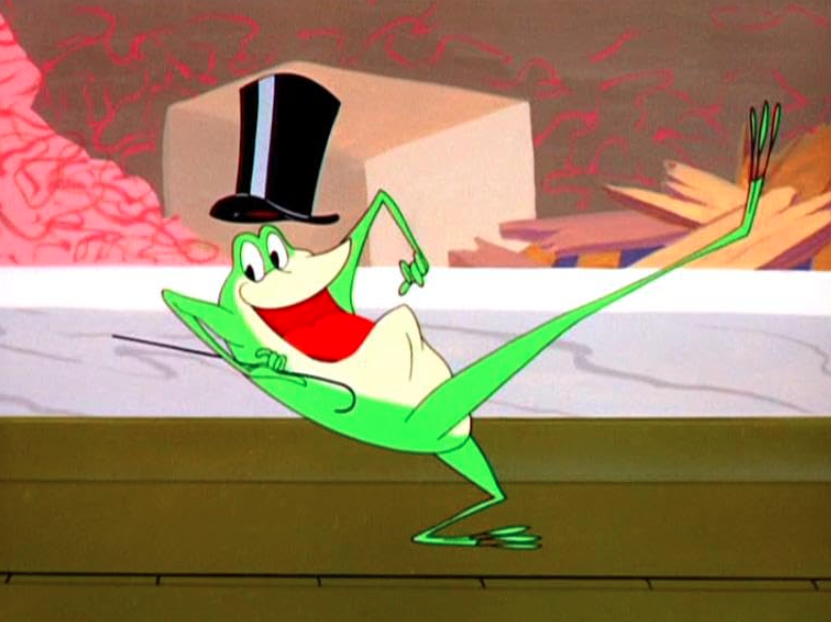
Images are copyright Warner Brothers Pictures.
Exclusive to MeierMovies, September 25, 2026
If you’re old, bitter and a bit crazy, maybe there’s a reason. Perhaps you’ve been driven that way by the world’s failure to see your potential, your talent, your uniqueness. Perhaps you imagine yourself a great writer, singer or painter, but things never worked out. Or maybe you had a revolutionary idea that was so obvious to you that you could almost reach out and touch it. But whenever you pitched it, you failed. Or maybe you’re just cursed.
If any of this rings true, you have a lot in common with the protagonist of a famous Warner Brothers animated short from 1955. Admittedly, this is an odd way to start a review of a cartoon. But that cartoon is One Froggy Evening, which Steven Spielberg called the “Citizen Kane of animated shorts,” apparently referencing both its brilliance and the main character’s tragic similarities to Charles Foster Kane.
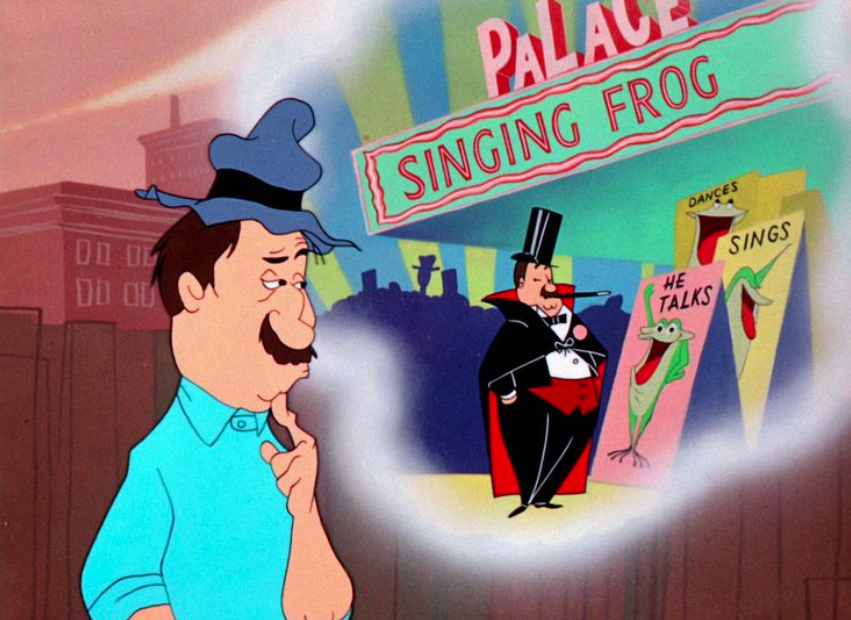 The short needs little explanation, other than the words “singing frog” and “Hello! Ma Baby,” the latter being the late 19th-century tune toadie loves to croon. The lead character, a construction worker, finds said frog in the foundation stone of an 1892 building that is being demolished to make way for a modern high rise. Predictably, he envisions fame and fortune. But every time he shows off the animal, it only croaks. And so do his dreams, until, after wasting his life’s savings to promote the frog, he is left homeless, destitute and confined to a mental hospital. This is not your typical Looney Tune.
The film ends with the man, released from the asylum, finally ridding himself of the frog the same way the last victim presumably did: by hiding the amphibian in the foundation stone of a new erection. Fast forward to 2056, when a fresh patsy finds him – and the circle continues.
In addition to being a commentary on life’s hardships, the film cautions against exploiting others, putting all your frogs in one basket and counting your tadpoles before they have hatched. It’s also bitingly funny and blisteringly sad, simultaneously. Not many filmmakers not named Charlie Chaplin can do that. And though the animation and art direction don’t quite rise to the level of most Disney cartoons, or some of the other great Warner Brothers offerings such as What’s Opera, Doc? and Duck Dodgers in the 24 ½ Century, the hand-drawn art is wonderful, as is the story by Michael Maltese and the direction by the great Chuck Jones, who later named his creation Michigan J. Frog (for the film’s one original song, “The Michigan Rag”).
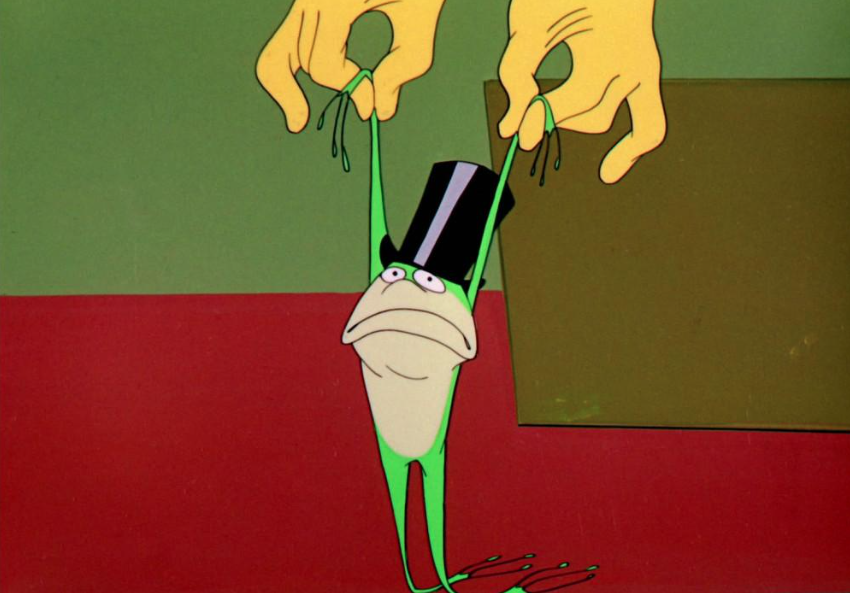 Jones realized the enduring popularity of the film so much that he eventually made a sequel, Another Froggy Evening, in 1995, just seven years before his death at the age of 89. Though the cartoon is vastly inferior to the original, it confirmed what we suspected all along: Michigan J. Frog is eternal, having tortured men from caveman days, to Stone Age Britain, to Ancient Rome, to Colonial America, to the Space Age. Yet, charmingly, regardless of the time, he always sings Tin Pan Alley ditties from the late 19th and early 20th centuries.
The odd story was inspired by supposedly real events. In 1928, in Texas, a horned toad was found in a time capsule from 1897 – alive! Although the story was almost certainly a hoax, it inspired public fascination and a magazine article, which then inspired a 1940 radio play, which in turn informed Once Upon a Time, a 1944 Cary Grant movie about a dancing caterpillar in a shoebox. One Froggy Evening borrowed from all of these, but it’s the only one most people remember, and rightfully so.
If you’re alive in 2056, I hope you will watch One Froggy Evening again. But I pray that, by then, you have jettisoned your own proverbial singing frog and lived a life worthy of your own talents and dreams.
For more on the odd history of the tales that inspired the film, visit Wikipedia. You might also find the history of “Hello! Ma Baby” interesting.
© 2026 MeierMovies, LLC
Warner Brothers protects its copyright, so finding a complete, high-res, free version online is difficult. At the time of publication, this Reddit video was the best I could find.
The cartoon inspired this unforgettable scene from Mel Brooks’ Spaceballs, in 1987: