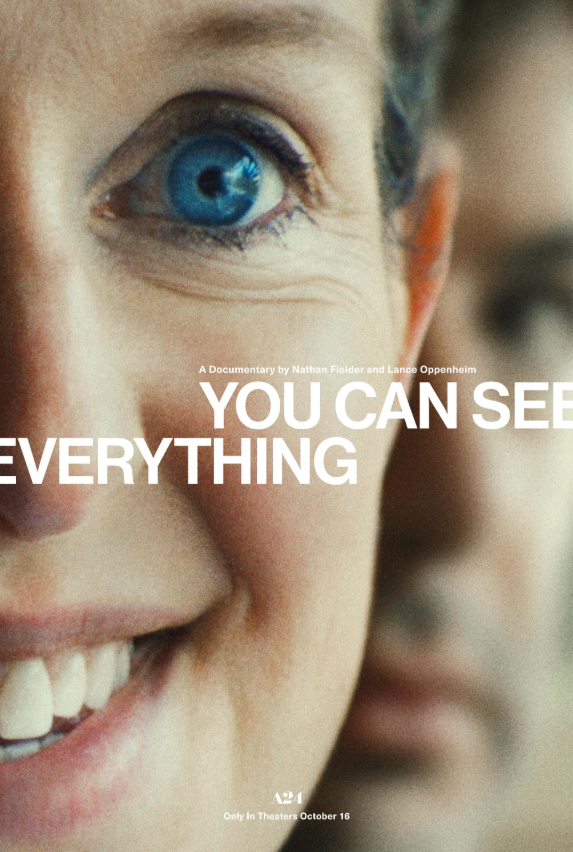
You Can See Everything
You Can See Everything, 2026, 4 ¼ stars
See change
Make way for a new type of doc
 Exclusive to MeierMovies, October 16, 2026
Human identity is perhaps the most important subject of cinema: Who are we, and how will we be remembered?
It’s been that way since 1896 when, after seeing some of the Lumiere Brothers’ first films, Russian writer Maxim Gorky wrote that death is no longer final, articulating what we now take for granted, that motion pictures have made man immortal.
But because our flesh won’t survive to experience that celluloid immortality, we’re naturally more concerned with how we are perceived while we’re alive. And that is apparently the reason convicted felon Elizabeth Holmes allowed directors Nathan Fielder (comedian/actor/producer) and Lance Oppenheim (director of Some Kind of Heaven and Primetime) to film her and her family in their home for a month leading up to her incarceration in 2023.
The filmmakers achieved this “radical transparency” by Fielder living temporarily with Holmes, her boyfriend Billy Evans and their two kids in their seaside San Diego rental house. He had almost constant, unlimited access, going so far as to eat meals with them and even swim in the Pacific Ocean with Holmes. In this regard, Fielder becomes another subject of the documentary, blurring the line between interviewer and interviewee.
This odd relationship might not make the best journalism, but it does make fascinating filmmaking. And, at least in this case, it makes the best documentary of the year.
Confession: Going into the film, I didn’t know much about Holmes or her apparent scheme to defraud investors in her health-technology company, Theranos, and I didn’t really care. I also had never seen The Dropout, the 2023 Hulu miniseries starring Amanda Seyfried as Holmes. In addition, the first 20 minutes of You Can See Everything seemed to me like a tedious, gimmicky – though meticulously crafted – reality-television show. I was suspicious of the directors’ intentions and not wholly on board with the extreme close-ups and minutia of daily life. Further, the music and cinematography were reminiscent not of documentary filmmaking but of narrative fiction.
But then things came slowly into focus. I might not have understood it all – and still don’t – but, as the title suggests, I was able to see everything.
What I saw was a mind-bending examination of reality, identity and documentary filmmaking itself. Though the film follows Holmes’ story for roughly three years, it ends up being less about her and more about us. Indeed, because Fielder and Oppenheim didn’t have access to Holmes once she went to prison, they invented other ways to tell the story. To do so, they adopted a metatheatrical, deconstructionist alternate reality rarely seen in any film, let alone a doc. The closest comparisons are perhaps The Act of Killing (2012) and Jim & Andy: The Great Beyond (2017), but You Can See Everything is a work of art all its own and, along with Digger, one of the two most original films of 2026.
During one of the three-hour movie’s myriad uncomfortable and deeply personal encounters, Evans gives Fielder unusual insight into Holmes. “She’s weird,” he says. “She’s not normal.”
The same could be said of the movie, and that’s a very good thing.
© 2026 MeierMovies, LLC
For more information on the movie, visit IMDB and Wikipedia. The film is currently playing in cinemas in North America. It is rated R.